
Pass crossingMuktinath includedJomsom flight included🥾 Trekking🧗 Adventure🛕 Pilgrimage

Annapurna Circuit with Thorong La

Besisahar to Jomsom over a 5,416 m pass, with Muktinath on the far side

  • Besisahar · Manang · Thorong Phedi · Thorong La · Muktinath · Jomsom
  • 15 days, 14 nights
  • Packed pace · Active
  • 4.7(233 reviews)

Overview

In short

The Annapurna Circuit is not the trek it was in 1990, and pretending otherwise does nobody any favours. A road now runs up the Marsyangdi as far as Manang and down the Kali Gandaki from Muktinath, so the classic 21-day walk has been cut to about 11 walking days, with jeeps covering the sections where you would otherwise share the trail with cargo trucks. What survives is the part that made the route famous: the climb from Chame's pine forest to the arid Tibetan-plateau landscape at Manang, the acclimatisation days under Gangapurna, and the pre-dawn crossing of the Thorong La at 5,416 m — six to eight hours from Thorong Phedi in temperatures that routinely sit below minus 15. On the far side, Muktinath is a working pilgrimage site sacred to both Hindus and Buddhists, with 108 water spouts and an eternal flame in the Jwala Mai temple.

Trek specification

Strenuous
Grade
Strenuous
Maximum altitude
5,416 m
Distance on foot
145 km
Walking per day
5–8 hours
Nights on trail
Teahouse lodges throughout — comfortable with en-suite options to Manang, then basic and unheated at Yak Kharka and Thorong Phedi where only two lodges exist
Best seasons
Mid-October to late November and late March to mid-May. The Thorong La is often closed by snow from December to February, and the monsoon makes the Marsyangdi landslide-prone even though Muktinath itself sits in the rain shadow.

Permits arranged for you

Thorong La, 5,416 m is the high point of this route. Annapurna Conservation Area Permit (ACAP), NPR 3,000 (about USD 22), TIMS card, NPR 2,000 (about USD 15). We file these on your behalf; the cost is inside your package price unless the exclusions say otherwise.

The altitude profile

Where you sleep each night, day one to day 15. This is the chart worth reading before the itinerary — it is what determines whether you enjoy the trek.

5,416 mDay 1Day 15
Highest point: Thorong La, 5,416 m. Flat stretches are acclimatisation days, not filler — the profile is drawn from the overnight stops in the itinerary below.

What you will actually do

  • Thorong La at 5,416 m, crossed on a 4am start from Thorong Phedi
  • Muktinath temple at 3,760 m, its 108 spouts and the natural gas flame
  • Full acclimatisation day at Manang, 3,540 m, with the Gangapurna glacier lake
  • The upper Pisang route via Ghyaru at 3,730 m, the best Annapurna II view on the circuit
  • The trans-Himalayan Kali Gandaki gorge and the walled village of Kagbeni
  • Jomsom to Pokhara by air, a 20-minute flight through the deepest gorge on earth
  • Jeep support on the road-affected lower sections rather than walking beside traffic

Day by day

15 days planned in full. Drive times and walking hours are stated so you can judge the pace before you book.

  1. Day 1

    Arrive Kathmandu

    Kathmandu
    Met at Tribhuvan International and driven to Thamel at 1,400 m. Gear check in the afternoon with particular attention to the pass day: an insulated jacket, windproof shell, liner and outer gloves, and boots that fit over two pairs of socks. ACAP and TIMS paperwork is completed the same day and the pass-day plan is explained in detail.
    Meals included
    No meals included
    Overnight
    3-star hotel, Thamel
    Transfer
    Airport to hotel, 25 minutes
  2. Day 2

    Drive to Besisahar

    Besisahar
    Seven hours west on the Prithvi Highway then north up the Marsyangdi to Besisahar at 760 m, the administrative town where the circuit traditionally begins. The road is tarmac most of the way and rough for the last hour. Besisahar is hot, humid and unremarkable, which makes tomorrow's climb into the hills a relief.
    Meals included
    Breakfast, Dinner
    Overnight
    Lodge, Besisahar
    Transfer
    Kathmandu to Besisahar, 7 hours by private vehicle
  3. Day 3

    Jeep up the Marsyangdi to Chame

    Chame
    Six hours by shared jeep on a road cut into the gorge wall, gaining 1,900 m to Chame at 2,670 m. This section used to take four walking days and now runs beside vehicles the whole way, which is why we drive it. Chame is the district headquarters of Manang, has pine forest, hot springs and the first apple orchards.

    Chame hot spring ·Marsyangdi gorge

    Meals included
    Breakfast, Lunch, Dinner
    Overnight
    Teahouse, Chame
    Transfer
    Besisahar to Chame by jeep, 6 hours
  4. Day 4

    Chame to Upper Pisang

    Upper Pisang
    Five to six hours and 630 m up, walking properly at last. The trail passes the Paungda Danda rock face, a 1,500 m curved granite slab rising straight from the river, then climbs through pine to Upper Pisang at 3,300 m. The village is stacked in tiers with a gompa at the top and Annapurna II filling the south skyline.

    Paungda Danda ·Upper Pisang Gompa

    Meals included
    Breakfast, Lunch, Dinner
    Overnight
    Teahouse, Upper Pisang
  5. Day 5

    Upper Pisang to Manang via Ghyaru and Ngawal

    Manang
    Six to seven hours on the high route, which climbs 430 m to Ghyaru at 3,730 m before contouring through Ngawal and dropping to Manang at 3,540 m. It is harder than the valley road and better in every other respect: Annapurna II, III and IV across the valley, and two medieval Tibetan-style villages instead of dust.

    Ghyaru ·Ngawal ·Braga Monastery

    Meals included
    Breakfast, Lunch, Dinner
    Overnight
    Teahouse, Manang
  6. Day 6

    Acclimatisation day at Manang

    Manang
    A rest day spent gaining and losing altitude. Options are the Gangapurna glacial lake and the viewpoint above it at 3,900 m, or a harder climb toward Ice Lake. The Himalayan Rescue Association posts a free altitude-sickness talk at 3pm in season, and it is the best hour you will spend on this trek. Sleep back at 3,540 m.

    Gangapurna Lake ·HRA Manang aid post ·Manang old village

    Meals included
    Breakfast, Lunch, Dinner
    Overnight
    Teahouse, Manang
  7. Day 7

    Manang to Yak Kharka

    Yak Kharka
    Four hours and just 510 m of gain, kept short on purpose. The trail leaves the Marsyangdi and climbs north-west past Tenki and Gunsang into open grazing country where the last juniper gives out. Yak Kharka at 4,050 m is exactly what its name says: a yak pasture with three lodges and blue sheep on the slopes above.

    Gunsang ·Yak pastures

    Meals included
    Breakfast, Lunch, Dinner
    Overnight
    Teahouse, Yak Kharka
  8. Day 8

    Yak Kharka to Thorong Phedi

    Thorong Phedi
    Three to four hours and 475 m, over a landslide-prone traverse above the Jarsang Khola that needs care in wet conditions. Thorong Phedi at 4,525 m is two lodges at the foot of the pass and nothing else. Dinner is early, bags are packed the night before, and lights are out by eight because tomorrow starts at four.
    Meals included
    Breakfast, Lunch, Dinner
    Overnight
    Teahouse, Thorong Phedi
  9. Day 9

    Thorong La at 5,416 m, down to Muktinath

    Muktinath
    Eight to ten hours, the hardest day on the circuit. Leave at 4am for the 900 m climb to the pass at 5,416 m, reached in four to five hours; wind picks up dangerously after mid-morning, which is why the start is so early. From the prayer flags it is a relentless 1,650 m descent to Muktinath at 3,760 m.

    Thorong La ·Chabarbu

    Meals included
    Breakfast, Lunch, Dinner
    Overnight
    Teahouse, Muktinath
  10. Day 10

    Muktinath temple, walk down to Kagbeni

    Kagbeni
    The morning at Muktinath: the Vishnu temple with 108 bull-head water spouts, the Jwala Mai shrine where natural gas burns above a spring, and a steady flow of Hindu and Buddhist pilgrims, many of them Indian. Then three hours downhill through Jharkot to Kagbeni at 2,810 m, a mud-walled village at the Upper Mustang checkpoint.

    Muktinath Temple ·Jwala Mai ·Jharkot ·Kagbeni Gompa

    Meals included
    Breakfast, Lunch, Dinner
    Overnight
    Teahouse, Kagbeni
  11. Day 11

    Kagbeni to Jomsom along the Kali Gandaki

    Jomsom
    A short two-and-a-half-hour walk down the wide gravel bed of the Kali Gandaki to Jomsom at 2,720 m. Set off early: the valley wind reliably rises to gale force by 11am and blows dust straight up the gorge. Jomsom has apple brandy, a mountaineering museum and the airstrip you fly from tomorrow.

    Kali Gandaki riverbed ·Jomsom Mountaineering Museum

    Meals included
    Breakfast, Lunch, Dinner
    Overnight
    Lodge, Jomsom
  12. Day 12

    Fly Jomsom to Pokhara

    Pokhara
    A 20-minute morning flight between Dhaulagiri and Annapurna I through the deepest gorge on earth, landing at Pokhara at 822 m. Flights operate before 10am only, because of the same wind, and cancel in cloud — if that happens we drive the eight hours instead. The afternoon is free on Lakeside.
    Meals included
    Breakfast
    Overnight
    3-star hotel, Pokhara Lakeside
    Transfer
    Jomsom to Pokhara, 20-minute flight
  13. Day 13

    Free day in Pokhara

    Pokhara
    Deliberately unscheduled, and it doubles as the buffer if the Jomsom flight was delayed. Sarangkot at 1,600 m gives an Annapurna sunrise 40 minutes from the hotel, the International Mountain Museum covers Himalayan climbing history properly, and Phewa Lake has rowing boats. Or you sit still, which after the Thorong La is a defensible choice.

    Sarangkot ·International Mountain Museum ·Phewa Lake

    Meals included
    Breakfast
    Overnight
    3-star hotel, Pokhara Lakeside
  14. Day 14

    Pokhara back to Kathmandu

    Kathmandu
    A 25-minute flight or a six-to-seven-hour drive back to Kathmandu, arriving by early afternoon. The evening is a farewell dinner in Thamel with your guide and a chance to sort photographs and certificates. Anyone with an early departure can pre-check their bags with most airlines from the city office.
    Meals included
    Breakfast, Dinner
    Overnight
    3-star hotel, Thamel
    Transfer
    Pokhara to Kathmandu, 25-minute flight
  15. Day 15

    Depart Kathmandu

    Kathmandu
    Airport transfer three hours before your flight. With time to spare, Patan Durbar Square or Bhaktapur are both under an hour away and neither requires any walking uphill. We can hold your room until midday for a small supplement if your departure is late in the evening.
    Meals included
    Breakfast
    Transfer
    Hotel to airport, 30 minutes

What the price covers — and what it does not

Included

  • 14 nights' accommodation — 3 nights 3-star hotels in Kathmandu and Pokhara, 11 nights lodges
  • All meals on trek plus breakfast in the cities and two dinners (14 breakfasts, 11 lunches, 12 dinners)
  • Annapurna Conservation Area Permit, NPR 3,000 (about USD 22)
  • TIMS card, NPR 2,000 (about USD 15)
  • Private vehicle Kathmandu to Besisahar and shared jeep Besisahar to Chame
  • Jomsom to Pokhara flight and Pokhara to Kathmandu flight
  • Licensed English-speaking guide for 12 days plus an assistant from six trekkers
  • One porter shared between two trekkers, 24 kg combined limit
  • Pulse oximeter monitoring from Manang and a guide-carried first-aid kit with Diamox
  • All airport and hotel transfers in Kathmandu and Pokhara
  • 24×7 operations support from the HighPass Kathmandu desk

Not included

  • International flights to Kathmandu and the Nepal visa fee
  • Travel insurance with helicopter evacuation and cover to 5,500 m
  • Hot showers and device charging in teahouses, USD 3–6 each above Manang
  • Bottled or boiled drinking water on trail, USD 1–4 a litre
  • Lunches and dinners in Kathmandu and Pokhara other than the two included
  • Tips for guide, assistant and porters, about USD 12–15 per trekker per day
  • Road transfer costs if the Jomsom or Pokhara flight is cancelled and we drive instead
  • Sarangkot paragliding, museum entries and any activity on the free day
  • Personal gear, laundry, alcohol and anything not listed above

Upcoming departures

Small group, maximum 10 trekkers. Seat counts are live at the last catalogue update; we confirm availability in writing before taking any payment.

  • Mon21SEPT2026

    Departs Kathmandu

    Available10 left

  • Mon12OCT2026

    Departs Kathmandu

    Last few seats4 left

  • Mon02NOV2026

    Departs Kathmandu

    Filling fast7 left

  • Mon29MAR2027

    Departs Kathmandu

    Available9 left

  • Mon26APR2027

    Departs Kathmandu

    Filling fast5 left

  • Mon24MAY2027

    Departs Kathmandu

    Available10 left

Questions about this trip

Has the road ruined the Annapurna Circuit?

It has changed it, substantially. Jeeps now reach Manang and the road runs down the Kali Gandaki from Muktinath, so about four of the original walking days are gone. What remains — Chame to Manang, the acclimatisation days, the Thorong La and the descent to Muktinath — is still among the best trekking in Nepal. We drive the road sections rather than pretend they are walkable.

What happens if the Thorong La is closed?

Heavy snow closes the pass some years, occasionally for a week at a time, most often in late October storms and in winter. If it is shut we wait a day at Manang or Yak Kharka, and if it stays shut we return the way we came and drive round to Muktinath via Pokhara and Jomsom. You still see Muktinath; you do not cross the pass.

How cold is the pass day?

Leaving Thorong Phedi at 4am in November, air temperature is commonly minus 15 to minus 20 Celsius, with a wind that makes it feel worse. You want an insulated jacket, a windproof shell, liner plus outer gloves, a balaclava, and boots roomy enough for two sock layers. It warms quickly once the sun clears the ridge at around 7.30am.

Is Muktinath worth it for a non-pilgrim?

Yes, though the reason changes. For Hindu and Buddhist pilgrims it is one of the most significant sites in the Himalaya, with 108 water spouts and a natural gas flame burning above a spring. For everyone else it is a functioning place of worship at 3,760 m in a trans-Himalayan landscape, busy with Indian and Nepali visitors and quite unlike the rest of the trek.

Do I need Diamox for this trek?

Not automatically. The itinerary is built to acclimatise you without it, with a Manang rest day and short stages to Yak Kharka and Thorong Phedi. Some trekkers take a prophylactic dose from Manang on their doctor's advice, and our guides carry it for emergency use. Discuss it with your own doctor before you fly, not with a lodge owner.

You might also consider

Similar trips

Ghorepani Poon Hill Trek — Pokhara · Nayapul · Ulleri · Ghorepani · Poon Hill · Ghandruk
Short trekGroup saver
Pokhara · Nayapul · Ulleri · Ghorepani · Poon Hill · Ghandruk3,210 m
5D / 4N4.6(412)

Ghorepani Poon Hill Trek

Four nights, a 3,210 m sunrise, and the stone steps to Ulleri

  • Land only
  • Teahouse
  • All meals on

From, per person

$580

$115/day
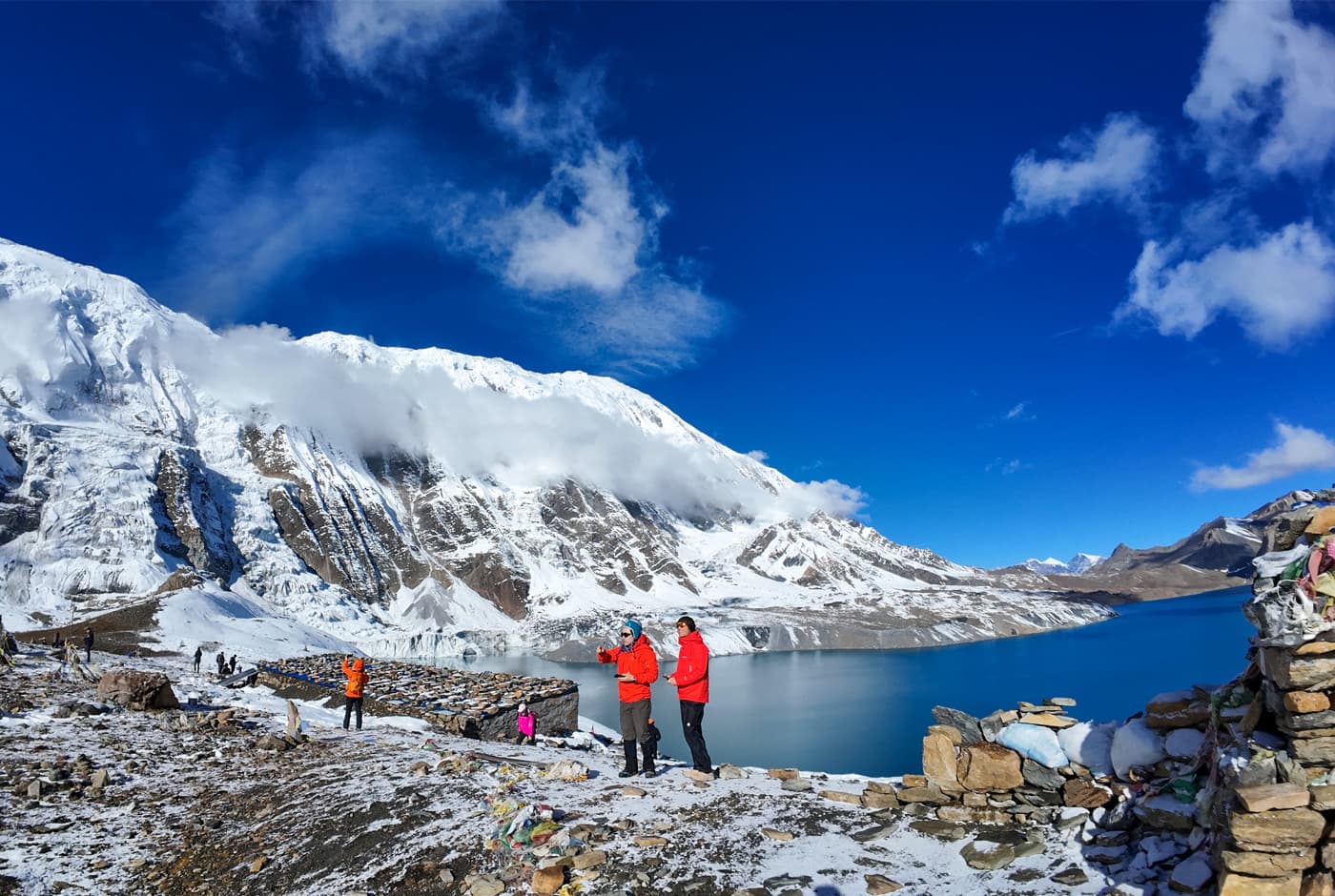
Tilicho Lake Trekking — Kathmandu-Besisahar-Tilicho
BestSeller
Kathmandu-Besisahar-Tilicho4,919 m
12D / 11N5.0(0)

Tilicho Lake Trekking

Tilicho Lake

  • Land only
  • Teahouse
  • Breakfast, Lunch &

From, per person

$7000

$60/day

Mardi Himal Trek — Pokhara · Australian Camp · Forest Camp · High Camp · Mardi Himal View Point
Quieter trailRidge walking
Pokhara · Australian Camp · Forest Camp · High Camp · Mardi Himal View Point4,500 m
7D / 6N4.8(196)

Mardi Himal Trek

Ridge walking above the cloud to a 4,500 m viewpoint below Machhapuchhre

  • Land only
  • Small
  • All meals on

From, per person

$720

$105/day

Annapurna Base Camp Trek — Pokhara · Ghandruk · Chhomrong · Deurali · ABC · Jhinu Danda
Save 15%Sanctuary night
Pokhara · Ghandruk · Chhomrong · Deurali · ABC · Jhinu Danda4,130 m
11D / 10N4.8(271)

Annapurna Base Camp Trek

Into the Annapurna Sanctuary at 4,130 m, finishing at the Jhinu hot springs

  • Land only
  • Teahouse
  • All meals on

From, per person

$1,050$1,240

$95/day